
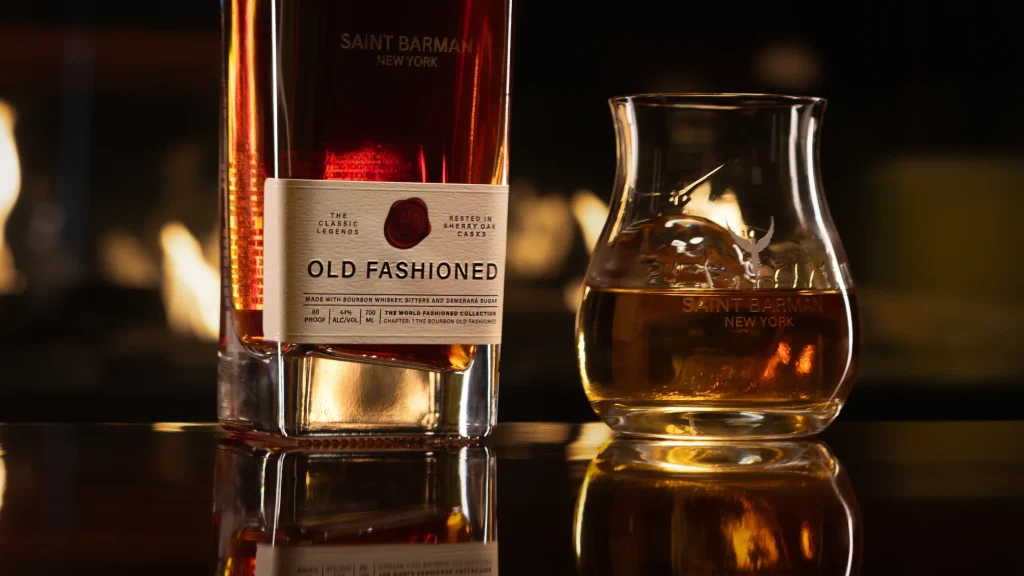
With a meticulously crafted Old Fashioned, a global approach to ingredients, and an uncompromising philosophy, SAINT BARMAN is redefining what a premium Ready-to-Serve cocktail can be.
Convenience has become one of the defining forces shaping the modern drinks industry. But as the Ready-to-Serve cocktail category continues to evolve, the conversation is shifting from simply making cocktails easier to access to a much bigger question: Can convenience coexist with true cocktail craftsmanship?
For SAINT BARMAN, the answer is yes — but only if nothing is compromised along the way.
The brand entered the category with a clear purpose: “To craft exceptional drinks for enthusiasts to savor wherever you are, to celebrate life, and to preserve the cocktail culture”
“Our aim is not to replace the bar or the bartender, but to bring the world-class bar wherever you are,” says Tural Hasanov, Brand Manager for SAINT BARMAN.
It is an important distinction for a brand entering a space often associated with convenience first. SAINT BARMAN instead positions the bottle as an extension of the cocktail experience — one capable of traveling beyond the traditional bar without losing sight of the craftsmanship and culture that created it.
Starting With a Classic
For its first expression, SAINT BARMAN went back to the foundations of cocktail history: the Old Fashioned.
The inspiration traces back to May 13, 1806, when The Balance and Columbian Repository published what is widely recognized as one of the earliest printed definitions of a cocktail: a combination of spirit, sugar, water, and bitters.
The formula is strikingly familiar. Strip an Old Fashioned down to its essentials, and those same elements remain.
That connection became the starting point for SAINT BARMAN’S inaugural release.
Rather than reinventing the cocktail entirely, the brand focused on elevating its individual components, sourcing ingredients from different parts of the world, each selected for a specific contribution to the final drink.
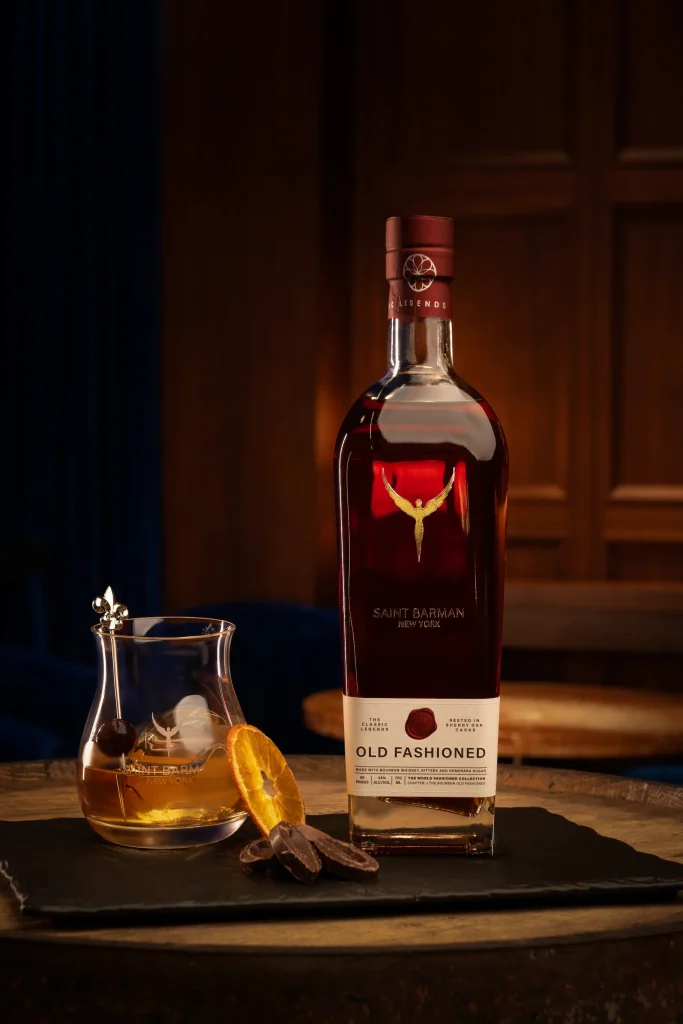
The bourbon features a 21% rye content, bringing spice to the profile. Pure demerara sugar adds depth, while dark cherries contribute richness, and orange essence and oil bring citrus freshness and aroma.
For SAINT BARMAN, “premium” is less about a label and more about what makes it into — and what happens inside — the bottle.
Crafted Beyond the Ingredients
The process continues in New York, where the ingredients come together.
Whiskey arrives from Kentucky in barrels before being blended with the remaining components. The finished mixture then spends additional time resting in a sherry cask, allowing the flavors to marry and develop balance.
Once the liquid reaches the desired quality, it is filtered once to remove larger particles and bottled at 88 proof.
According to Hasanov, the process is handcrafted from beginning to end, extending through labeling and packaging.
It is this attention to detail that supports the three values SAINT BARMAN uses as a benchmark for every product it develops:
EXCEPTIONAL. CONSISTENT. WORLD-CLASS.
And those values also determine what the brand won’t make.
Hasanov points to the Margarita as an example. Despite its popularity — and his own appreciation for the cocktail — SAINT BARMAN has chosen not to release one.
The reason is simple: in the brand’s view, a great Margarita depends on fresh lime and is best consumed fresh. If SAINT BARMAN cannot create a version that lives up to its standards, demand alone isn’t enough reason to put it in a bottle.
That restraint may ultimately say more about its definition of premium than any ingredient list could.
Convenience Without Replacing Cocktail Culture
Hasanov believes convenience is one of the strongest forces driving consumers toward Ready-to-Serve cocktails.
For many consumers, enjoying a great drink can mean navigating traffic, traveling into downtown districts, or planning an entire evening around the experience. Sometimes, gathering at home with friends and family simply makes more sense.
SAINT BARMAN wants to meet consumers in those moments.
The idea isn’t to recreate the atmosphere of a favorite cocktail bar in someone’s living room. Nor is it to suggest that a bottle can replace the person behind the bar.
Instead, SAINT BARMAN’S proposition is more straightforward: bring the quality of the drink closer to the consumer.
“Bring the world-class bar to you in a bottle,” as Hasanov describes it.
And despite being designed to be enjoyed outside the bar, hospitality remains central to how the brand intends to grow.
SAINT BARMAN offers 200ml bottles suited to settings such as hotel rooms, while viewing bartenders and hospitality professionals as important voices in introducing consumers to the brand.
“Brands are built on-premise,” Hasanov says.
The philosophy is rooted in discovery. A recommendation from a trusted bartender or hospitality professional can create that first interaction with the product. From there, SAINT BARMAN believes the drink should speak for itself.
The Next Chapters
The classic bourbon Old Fashioned is only the beginning.
SAINT BARMAN is currently developing what it calls its Classic Legends, with a Manhattan, Negroni, and Martini among the expressions being explored.
But the brand isn’t rushing them.
Hasanov says the Manhattan, for example, has been under development for some time and still hasn’t been released because it has yet to meet every standard the brand has established for itself.
There is also a more ambitious concept taking shape around the cocktail that started it all.
Look closely at the SAINT BARMAN Old Fashioned label, and you’ll find Chapter 1.
The idea behind the series asks a playful question:
What if the Old Fashioned had been created in another country?
Chapter 1 is the classic bourbon Old Fashioned. Chapter 2 is being developed around rum, followed by an añejo tequila expression for Chapter 3 and a reposado mezcal interpretation for Chapter 4, with eight chapters envisioned in total.
Each chapter gives SAINT BARMAN an opportunity to reinterpret one of cocktail culture’s foundational drinks through a different spirit and sense of place — while maintaining the standards behind the original.
And according to Hasanov, there is something else in development: something he describes only as “extremely unique and rare.”
For now, he’ll leave the rest undisclosed.
5 Questions with Tural Hasanov
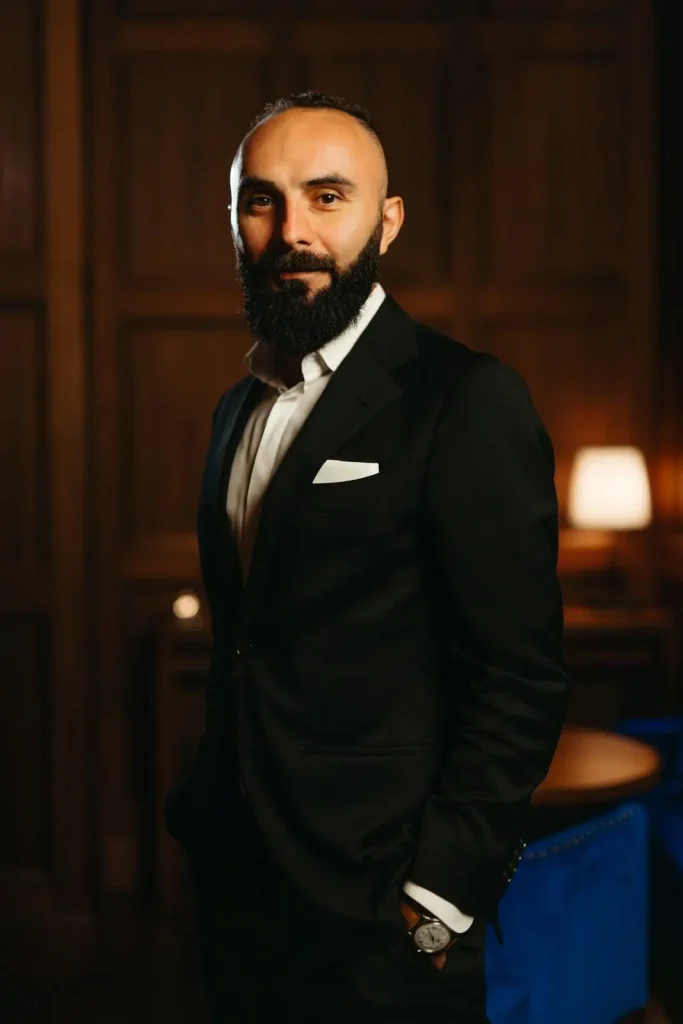
The Ready-to-Serve cocktail category has seen remarkable growth in recent years. What do you believe is driving consumers toward this segment?
Tural Hasanov: I would say it’s the convenience. Some people say it’s the ever-increasing prices, but I’m on the side of convenience. In the USA, people usually live away from downtowns, and as we all know, traffic gets crazy at certain times of the day and on weekends. So some people would rather have a cocktail at home with friends and family than drive for hours and sit in traffic. What SAINT BARMAN does is bring the world-class bar to you in a bottle.
Who is the ideal Saint Barman consumer, and when do you envision them enjoying the Old Fashioned?
TH: Whether it’s the purpose or the values, a SAINT BARMAN fan — as we call our consumers, because they become our fans and we become theirs — is someone who wants exceptional drinks with inspiring people at enchanting places.
What role do bartenders, hospitality professionals, and premium on-premise accounts play in helping consumers discover SAINT BARMAN?
TH: Any brand veteran will tell you that brands are built on-premise, and we are no different. We offer 200ml bottles, which are ideal for hotel rooms. Hospitality professionals have their influence, guests listen to their recommendations and try them. Our goal is for people to try SAINT BARMAN for the first time; after that, the product takes care of the rest.
While the Old Fashioned is your inaugural release, what’s next for SAINT BARMAN?
TH: We are currently working on our Old Fashioned lineup and the Classic Legends. From the Classic Legends, we will be releasing the Manhattan, Negroni, and Martini.
For the Old Fashioned lineup, we are developing a concept titled “Old Fashioned: What If It Was Created in Another Country?” If you notice, our label says Chapter 1, which is the classic bourbon Old Fashioned. We are working on Chapter 2 as a rum Old Fashioned, Chapter 3 as añejo tequila, Chapter 4 as reposado mezcal, and so on — totaling eight chapters.
I am also personally working on something extremely unique and rare that I will be able to share later.
Looking ahead, what is your long-term vision for SAINT BARMAN?
TH: We want to stay true to our values and pursue our purpose. SAINT BARMAN should be known for exactly that — we are laser-focused on our purpose and values, and that is what makes SAINT BARMAN different.